
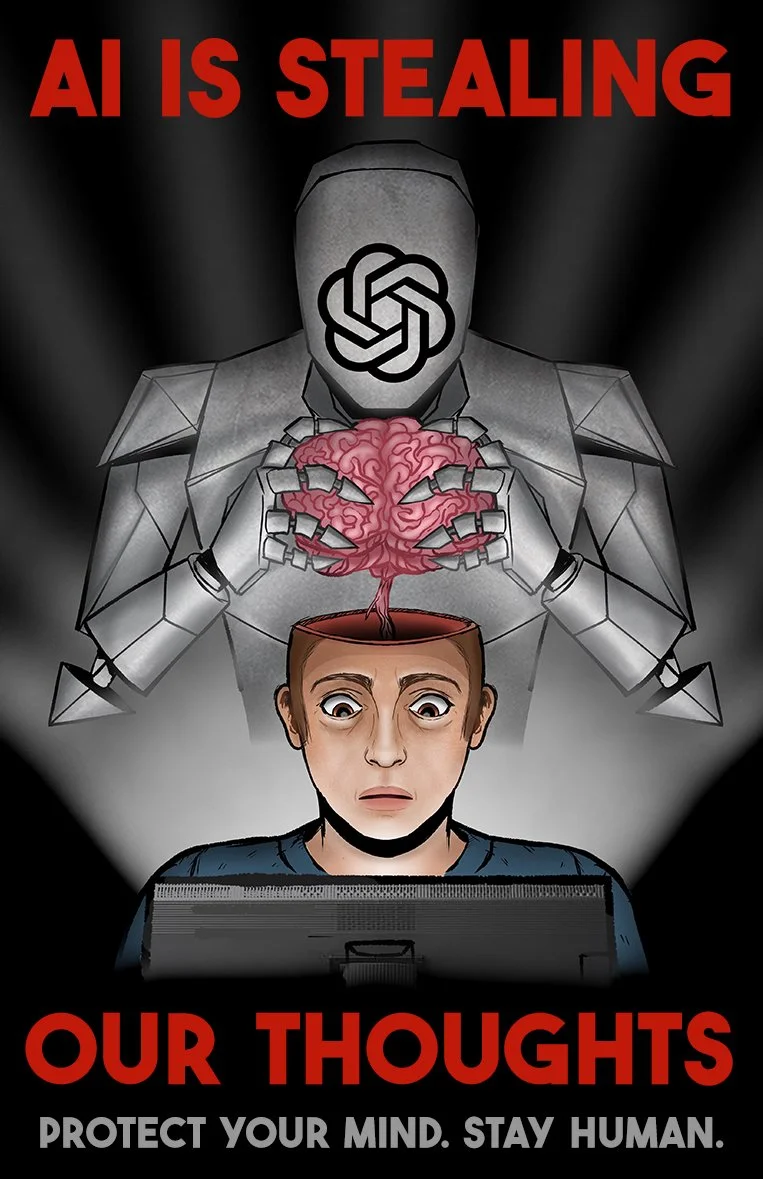
This propaganda poster is meant to call attention to the overwhelming overuse of AI in today’s world and how harmful it can be to our creativity and thinking skills.
The phrase “AI IS STEALING OUR THOUGHTS” uses a mix of name-calling and glittering generalities. It’s emotional, dramatic, and designed to make people stop and think about what’s really happening when they rely too much on AI. I wanted it to sound like a warning; something that hits hard and feels urgent. The text “Protect your mind. Stay human.” ties into that too, creating a sense of fear but also responsibility. Visually, personifying ChatGPT as a robotic figure literally taking the brain from the person in front of the screen uses the transfer technique. It connects AI to ideas of control, manipulation, and loss of identity.
Before making this poster, I was aware of an MIT study showing that ChatGPT users felt lonelier and had lower brain engagement the more they used it. That idea, of AI slowly dulling our minds, became the core of my message. I illustrated ChatGPT ripping the brain out of a person sitting at their computer, their expression dull and lifeless as they continued to stare blankly at the screen. I drew everything myself in IbisPaint and added the text later in Photoshop. The dark tones and lighting around the robot were intentional too, to make it feel eerie and dystopian, like something out of a modern cautionary poster.
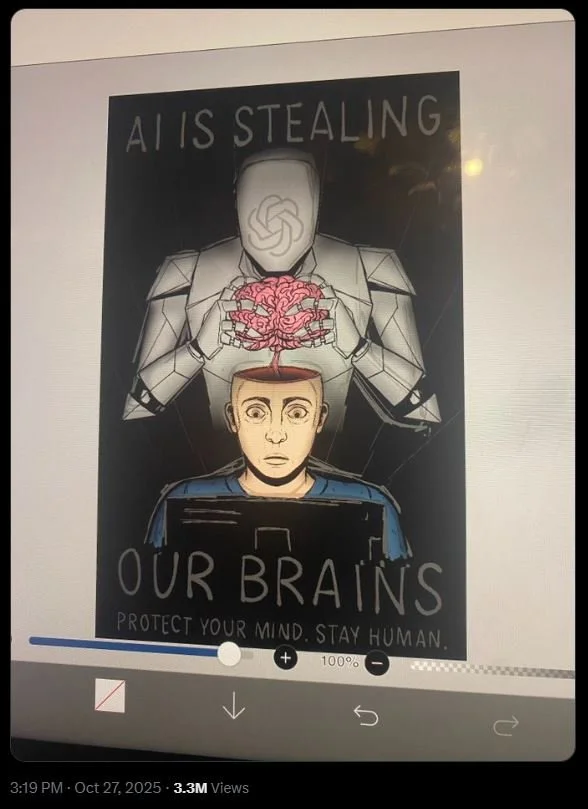
Originally, I just made this for class, but after sharing a work-in-progress on social media, it unexpectedly blew up. Over 3.3 million views and tons of people asking to buy it and hang it up in their town. That response made me realize that I’ve truly been successful with my poster. It’s connected emotionally with people and spread on its own. My audience started as my classmates and professor, but it turned into a much bigger one. My goal was to make people think twice about how much AI they use, and seeing that kind of reaction showed me that that message came through loud and clear.
Research

When I hear “I Want YOU for the U.S. Army,” I immediately picture Uncle Sam pointing straight at me. The slogan feels powerful and personal, like it’s calling me to do something important. It doesn’t sound like a general statement — it’s direct, almost commanding, and hard to ignore. There’s a mix of pride and pressure behind it; it makes joining the army sound like a duty rather than a choice.
I know this propaganda poster came from a time of war, when the U.S. was trying to recruit soldiers quickly. The use of “YOU” in all caps grabs attention and creates an emotional pull, as it’s both patriotic and persuasive. It’s stuck in my head because of how visual it feels, like the words themselves are pointing at me. The phrase is short, confident, and demands a reaction.
The slogan “I Want YOU for the U.S. Army” was created by artist James Montgomery Flagg in 1917 during World War I. It appeared on a recruitment poster featuring Uncle Sam pointing directly at the viewer, adapted from a British poster that said “Your Country Needs YOU.” The U.S. government used it to encourage enlistment by making the message feel personal — as if each citizen had a direct responsibility to serve.
Its power comes from how it blends patriotism with urgency. The combination of the word “YOU” and Uncle Sam’s gaze makes people feel individually chosen. Over time, the slogan’s meaning has shifted: once a serious wartime call to duty, it’s now an iconic symbol of American propaganda and pride. It’s memorable because of its emotional simplicity and how often it’s been reused and parodied in pop culture.
